Introduction
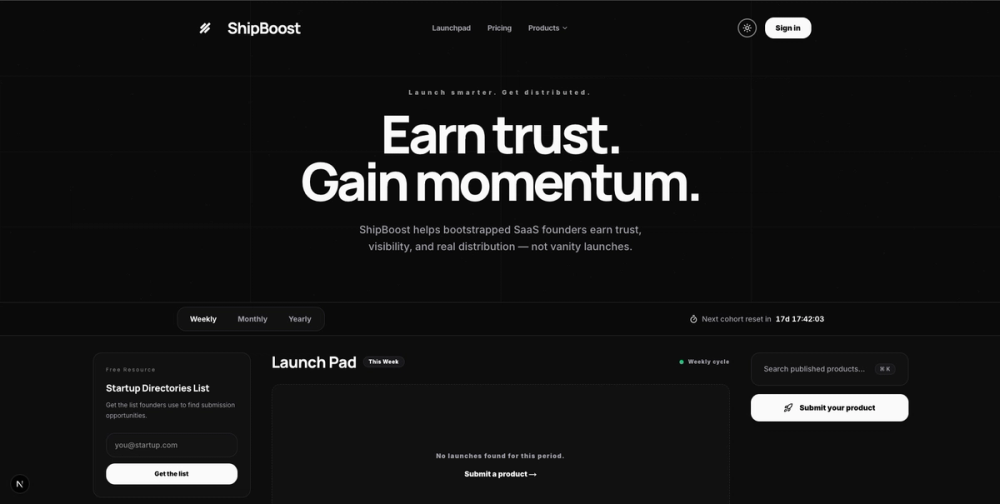
ShipBoost is a launch and discovery platform for bootstrapped SaaS founders who want their product launch to continue working after the initial launch window. The public site centers on weekly launch boards, founder-ready public listings, category and alternatives pages, and a startup-directory research resource. It is most relevant for founders who want a clearer launch surface and longer-tail discovery paths, while still needing to verify traffic maturity, fit, and submission expectations before treating it as a primary distribution channel.
Key Features
- Weekly launch board structure designed to keep launches readable instead of burying products in a fast-moving daily feed.
- Founder-ready public listings that remain useful after launch day, with founder-managed profiles after approval.
- Long-tail discovery paths through categories, tags, alternatives pages, and buyer-oriented comparison surfaces.
- Startup directory resource covering 336+ directories and launch sites, with access delivered by email.
- Free Launch and Premium Launch options, plus a partner done-for-you submission service for broader directory outreach.
- Submission workflow requiring an account, with draft saving and launch status tied to one founder workflow.
- Editorial launch spotlight included with Premium Launch during the launch period for the opening cohort.
- Category pages, including support-tool comparison pages, that help buyers browse tools by workflow, tags, and buying intent.
Use Cases
ShipBoost fits SaaS founders preparing a product launch who want more than a one-day visibility spike. The site positions a launch as a public asset: a weekly placement, a profile that remains discoverable, and category or alternatives pages that can continue attracting buyers after launch week rotates.
It can also support founders researching distribution options. The site promotes a hosted resource with 336+ startup directories and launch sites, which is useful for teams building a launch checklist or comparing where to submit a product. Founders who want wider outreach can review the partner done-for-you submission packages, though they should confirm delivery scope, reporting format, and directory fit before buying.
Buyers and evaluators may use ShipBoost's category pages to compare software in areas such as support, marketing, sales, development, finance, and operations. The support category page, for example, groups tools by tags such as Customer Support, Support Automation, Customer Messaging, Live Chat, Help Desk, and Shared Inbox, then points readers toward narrower buyer guides and nearby comparison pages.
Pricing
ShipBoost shows launch pricing for an opening cohort. Free Launch is listed at $0 per launch and includes weekly launchpad placement, a public listing on ShipBoost, a founder-managed profile after approval, and an optional badge for 24-48 hour priority review. Premium Launch is shown with a $19 price crossed against a $9 per launch founding offer, with 98 of 100 founding spots left at the time shown on the public page. Premium includes reserving a specific launch week, no badge step, stronger baseline board placement, a public listing that remains useful after launch, and one editorial launch spotlight during the launch period. A partner Done-for-you Submission option starts from $99 for 30+ AI directories, with Pro from $149 for 60+ directories and Premium from $199 for 100+ directories, plus a detailed submission report.
User Experience and Support
The site is organized around launchpad, pricing, products, categories, tags, submission, and account access. A founder can browse the launch concept, compare pricing, review categories, submit a product, and create an account to manage a draft, listing, and launch status. The submission page says users can save a draft and return later, which reduces pressure to finish a listing in one session.
Support and trust signals include an FAQ area, contact link, privacy and policy navigation, launch guide references, and pages explaining how ShipBoost works. The site also shows "Featured on" mentions for startup directories and launch communities. Readers should still verify response times, refund rules, review criteria, and partner-service terms directly, especially if they are paying for Premium Launch or done-for-you submissions.
Technical Details
ShipBoost is a web platform for SaaS launch distribution and software discovery rather than a developer infrastructure product. Visible surfaces include a weekly board, product profiles, categories, tags, alternatives pages, support-tool comparison pages, a submission workflow, account login, pricing pages, and sponsor slots. The site also describes dashboard control over launch and listing management.
The platform requires an account for submission so the founder's draft, listing, and launch status stay connected. Public pages do not show API access, webhooks, export options, team roles, or direct integrations for managing listings. For founders planning a structured launch workflow, the important technical questions are likely account access, profile editing, launch timing control, reporting visibility, and how category or alternatives pages link back to the product site.
Pros and Cons
Pros
- Clear focus on bootstrapped SaaS founders who need launch visibility and post-launch discovery.
- Weekly launch boards, public listings, categories, tags, and alternatives pages give products multiple discovery surfaces.
- Free Launch option lowers the barrier for founders who want a credible listing and weekly visibility.
- Premium Launch pricing and included spotlight are explained plainly for the opening cohort.
- Startup-directory resource and partner submission packages may help founders plan broader distribution.
Cons
- The site notes that mature traffic proof is not yet established, so founders should calibrate expectations around reach.
- Done-for-you submission support is provided through a partner offer, so scope and quality should be verified before purchase.
- Public pages do not show detailed analytics, traffic estimates, conversion reporting, or buyer demographics.
- API access, integrations, team roles, and export features are not visible on the public pages.
- The value of category and alternatives discovery depends on how actively buyers use those surfaces over time.
FAQ
What is ShipBoost?
ShipBoost is a launch and discovery platform for bootstrapped SaaS founders. It combines weekly launch boards, founder-ready public listings, category and alternatives discovery paths, and a startup-directory resource.
Who is ShipBoost a good fit for?
ShipBoost is a good fit for SaaS founders preparing a launch who want visibility beyond a short launch-day spike. It is especially relevant for founders who want a public product listing, launch timing options, and discovery surfaces that can continue working after the weekly board changes.
What does the Free Launch plan include?
The Free Launch plan is listed at $0 per launch. It includes weekly launchpad placement, a public listing on ShipBoost, a founder-managed profile after approval, and an optional ShipBoost badge for 24-48 hour priority review.
What does Premium Launch add?
Premium Launch lets founders reserve a specific launch week, avoid the badge step, receive stronger baseline board placement, keep a public listing after launch, and get one editorial launch spotlight during the launch period. The public pricing page shows a founding offer of $9 per launch against a $19 crossed price.
Does ShipBoost offer done-for-you directory submissions?
Yes. The public pricing page shows a partner Done-for-you Submission offer starting from $99 for 30+ AI directories, with higher tiers for 60+ and 100+ directories. It also mentions a detailed submission report after delivery, but founders should review partner terms and expected deliverables before buying.
What is the startup directory resource?
ShipBoost promotes a founder resource with 336+ startup directories and launch sites. Access is sent by email, and the site positions it as a way to work through founder distribution research faster.
Does ShipBoost show traffic or performance proof?
The public page says that even before ShipBoost has mature traffic proof, it has real surfaces founders can use and buyers can browse. That wording is useful because it sets a cautious expectation: founders should not assume established traffic performance without checking current metrics or results.
How does the submission workflow work?
The submission page says founders need an account to submit to ShipBoost. The account keeps the draft, listing, and launch status tied to one workflow, and users can save a draft and come back later.
What should founders verify before paying?
Founders should verify current cohort availability, pricing, refund rules, review criteria, spotlight format, partner submission scope, reporting details, and whether ShipBoost's audience fits their product category. They should also check how much control they have over profile edits and launch timing.
Conclusion
ShipBoost offers a focused launch-distribution layer for SaaS founders, pairing weekly launch visibility with public listings and longer-tail discovery pages. Its Free Launch, Premium Launch, startup-directory resource, and partner submission options give founders several paths depending on budget and timing. The main caveat is that founders should confirm current reach, review standards, and paid-service details before relying on it as a core launch channel.